
How to prepare for furnace installation in East Alton
You've decided it's time for a new furnace. Good call. Your old system has been running 15, maybe 20 years, and it's starting to cost more to fix than it's worth. The question now is what happens next. If you've never had a furnace replaced before, you're probably wondering what installation day looks like and how you should get ready.
I'm Steve Janssen, and I've been doing HVAC work in East Alton, Edwardsville, Godfrey, and the surrounding areas for 21 years. I've installed hundreds of furnaces in homes just like yours. Most installations go smooth when the homeowner knows what to expect and the work area is ready. This post walks you through everything to do before installation day and what happens once the new furnace goes in.
Clear the work area before I arrive
Homeowners often store clutter around their furnaces during the warmer seasons, and leaving obstacles strewn about can complicate the HVAC installation. I need room to move, and a cramped space slows everything down.
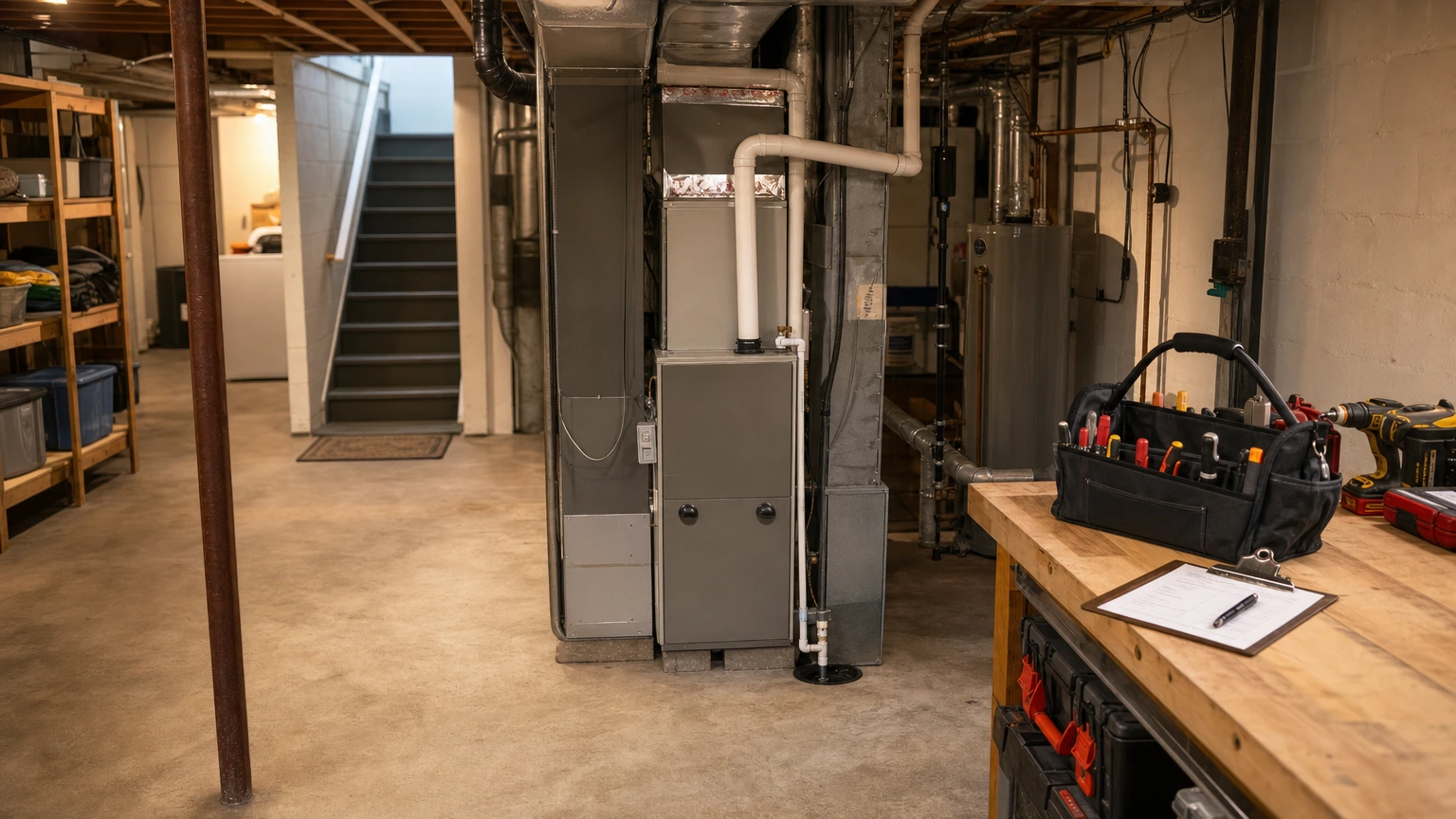
Clear the work area around your existing furnace, with at least five feet of clearance on all sides for installation and future maintenance. That means boxes, storage bins, old paint cans, holiday decorations, whatever has piled up near the furnace over the years. Move it out. Create a clear path from the entry to the furnace location, because I will be carrying heavy equipment and a clear path prevents damage and helps me work efficiently.
If your furnace is in the basement, make sure the stairs are clear. If it's in a utility closet, move anything blocking the door. The easier the access, the faster the job goes.
Know what installation day looks like
A furnace replacement typically takes 4 to 10 hours. Most of the standard replacements I do in East Alton finish in 4 to 6 hours, and the longer end is for jobs that need ductwork or venting changes.
I start by disconnecting power, gas, and duct connections, then pulling the old unit, which usually takes 1 to 2 hours. I clear the area and inspect the ductwork and venting while it is open. Then the new system gets positioned, leveled, and connected to the ductwork, electrical supply, and gas lines. Once it is in, I cycle the furnace on and test it for airflow, fuel delivery, temperature response, and safety.
Your heat will be off during the installation. Plan for that. If it's the middle of January, dress warm or plan to be out of the house for a few hours. Expect a temporary gas and power shutoff, so charge your devices and plan meals accordingly.
Get your home ready for the install
Beyond clearing the work area, a few other prep steps make installation day easier.
Clear the installation area before I arrive by moving any furniture, boxes, or other items blocking access to your furnace, electrical panel, or thermostat, and keep children and pets away from the work area. I've been on jobs where a dog won't stop barking at the tools or a toddler keeps wandering into the work zone. It's safer for everyone if kids and pets are somewhere else during the installation.
Replacing a furnace means disconnecting the lines that tie your old unit to the natural gas supply, and working with your home's electrical wiring to connect the new one. I can find the gas shutoff and the electrical panel myself, but if you already know where they are, point them out when I get there. It saves time.
Consider any issues that concern you ahead of time and compile them into a list, because doing so will help you get informed answers when I arrive. If you've had cold spots in certain rooms or the old furnace ran louder than it should have, write it down. I will address it during the install or the walkthrough.
Understand the sizing process
Before a new furnace goes in, I do a load calculation to make sure the replacement unit is sized correctly for your home, and this step matters more than most homeowners realize. A lot of older furnaces were oversized. That causes short cycling, uneven heating, and higher energy bills.
The calculation accounts for your square footage, ceiling height, insulation, window count, and how the existing system was set up, and I walk the existing system and measure the space to confirm what size replacement unit your home needs. For rough estimates, it is recommended that you allow 30 to 45 BTUs per square foot for furnaces in Illinois.
I run a Manual J calculation for every furnace I install. It tells me exactly how much heat your home loses on a cold day and what size furnace you need to replace it. The most dependable way to choose furnace size is with a professional heating load calculation, often called a Manual J calculation, which estimates how much heat your home loses on a cold winter day and identifies the capacity needed to replace that heat.
If your installer matches the size of your old furnace without measuring, ask why. That's a red flag.
Check your ductwork and thermostat before the install
I evaluate your home's gas lines, venting, ductwork, and electrical system to make sure they are compatible with your new furnace, and tell you if any upgrades are needed. Most of the time, existing ductwork is fine. But if your ducts are leaking or undersized, the new furnace won't perform the way it should.
I inspect ductwork before every install. If I see gaps, disconnected sections, or ducts that are too small, I'll tell you. Fixing it now saves you money later.
Many signs of a furnace malfunction result from a faulty thermostat and have nothing to do with the condition of the furnace itself, so check your thermostat before installation day: replace the batteries and make sure the settings are right. A dead thermostat battery can look like a furnace problem. Save yourself the confusion and swap the batteries before I arrive.
Plan for the permit and final inspection
Every furnace installation in East Alton requires a permit and inspection to ensure the work meets code. Not all contractors handle permits the right way. I do. The permit triggers the inspection, and that inspection confirms the work meets code.
The permit inspection is a separate visit, typically scheduled within a few days of the installation, and a city inspector comes to verify the work meets code. You don't need to do anything for the inspection except be available if the inspector needs access to the furnace area.
What happens after the install is done
Before I leave there is one last step: I walk you through the new system and show you how everything works, from the basic functions to the thermostat settings. I show you where the filter goes, how often to change it, and what settings to use.
I also go over annual tune-ups, which catch small problems early. Changing the filter every three months is the easiest way to keep your furnace running clean. Skipping it clogs the system and forces the blower to work harder than it should.
You'll have documentation for your warranty and the manufacturer specs. Keep that paperwork somewhere you can find it. If something goes wrong in five years, you'll need the model number and install date.
Ready to replace your furnace in East Alton?
If your furnace is struggling to keep up or you're tired of expensive repairs, a replacement makes sense. I've installed systems in homes all over East Alton, Godfrey, Bethalto, and Edwardsville. I'll sit down with you, measure your home, explain your options, and give you a straight price. No surprises, no upselling. Schedule service and let's get your home warm again.