
Best insulation for East Alton attics in Illinois climate
Your attic is either protecting your home or costing you money every single month. In East Alton, where summer heat pushes into the 90s and winter cold drops below freezing, the insulation you choose matters more than most people realize. The wrong type settles over time, lets moisture sneak in, or can't handle the swings. The right type keeps your HVAC from running nonstop and your energy bills from climbing year after year.
I've installed every type of attic insulation across Alton, Godfrey, Edwardsville, and Wood River. I've pulled out wet cellulose from crawl spaces, topped off fiberglass that settled six inches, and sealed attics with closed-cell foam that still perform like new a decade later. Illinois climate is tough on attics. You need insulation that handles both extremes without giving up halfway through.
What makes insulation work in Illinois weather
The R-value of insulation determines how well it resists heat flow, and in cold climates, a higher R-value is essential to keeping warm air inside your home and preventing heat loss through the attic. Living in the East Alton area means dealing with both extreme cold in the winter and hot, humid summers. Your attic insulation has to fight heat coming in during July and August, then hold heat inside when January hits.
In Illinois, blown-in insulation is perfect for tight spaces, as it provides better coverage in smaller areas and is less expensive than roll and batt insulation. But the real question isn't coverage. It's whether the insulation can stop air movement, manage moisture, and maintain its R-value after five winters and five summers of temperature swings.
Humidity is the other piece. Humid climates require air conditioning systems that not only cool the air but also manage indoor moisture levels effectively, and variable-speed fans adjust the system's cooling output based on humidity levels, allowing the unit to remove excess moisture from the air efficiently. Your attic insulation works the same way. If it can't handle moisture, you're looking at mold, rot, and performance loss.
Spray foam insulation for East Alton attics
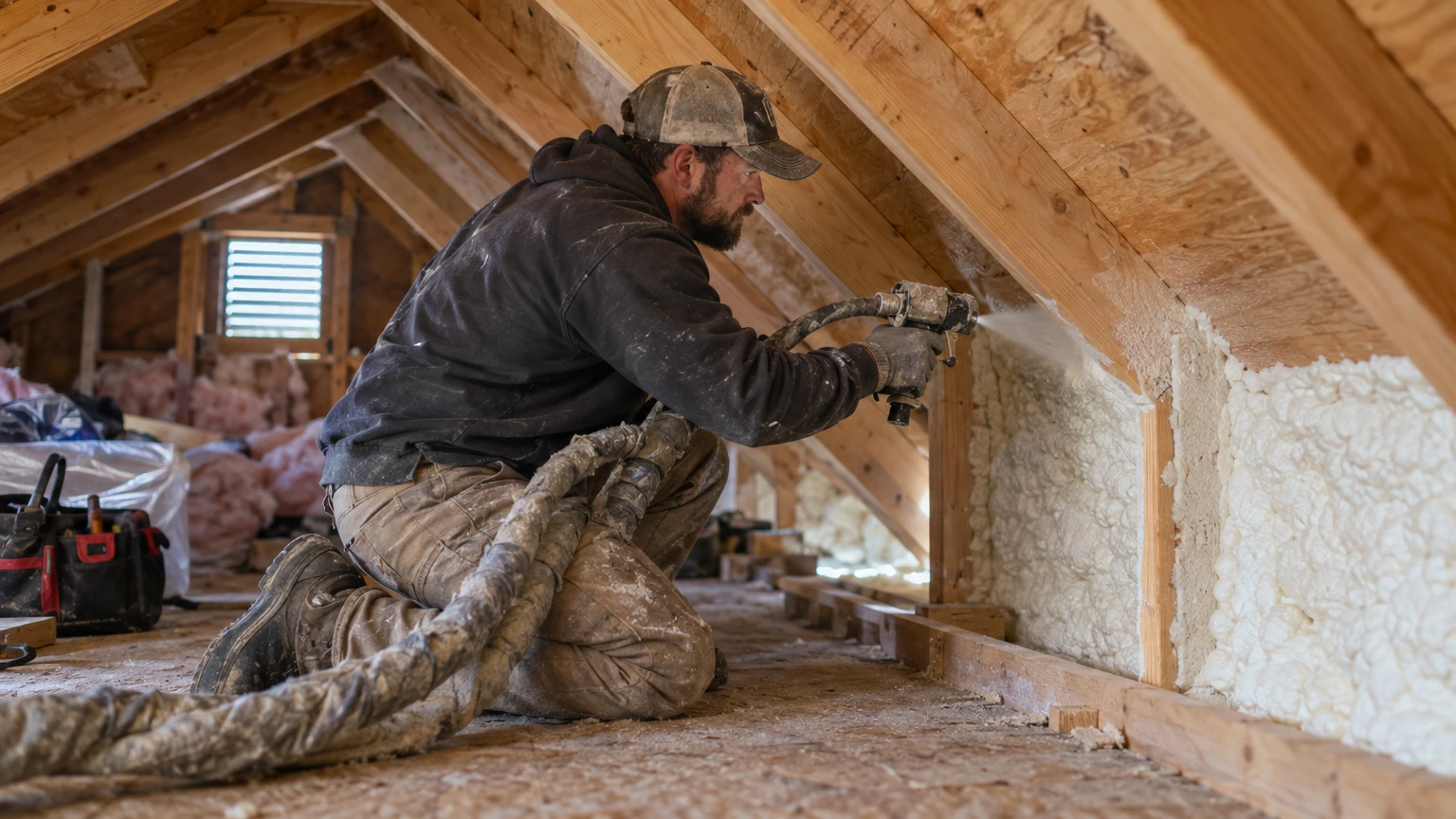
Closed-cell spray foam is the premium choice for Illinois attics, sealing every gap, stopping air movement, and acting as a vapor barrier all in one application.
Closed-cell spray foam is the premium choice for Illinois attics. It seals every gap, stops air movement, and acts as a vapor barrier all in one application. When I install closed-cell foam in an East Alton attic, I'm not adding R-value. I'm stopping air leakage at the source, which is where most energy loss happens.
Spray foam creates an airtight seal that virtually eliminates air infiltration, a significant advantage during winters when cold air seeks out every possible entry point, and closed-cell spray foam serves as a vapor barrier, preventing moisture migration that can lead to ice dams on roofs. Ice dams are common in Alton when warm air leaks into the attic, melts snow on the roof, and refreezes at the eaves. Closed-cell foam stops that cycle.
The downside is cost. Blown-in cellulose or fiberglass usually lands somewhere between $0.75 and $1.50 per square foot for attic coverage, making spray foam two to four times more expensive right out of the gate. But the payback is real. You're looking at 20 to 30 years of performance without settling, better moisture control, and lower energy bills month after month.
Open-cell spray foam is another option. It costs less than closed-cell and still gives you excellent air sealing. Open-cell spray foam expands to 100 times its original volume, offering sound-dampening properties but a lower R-value, while open-cell spray foam provides R3.5 to R3.7 per inch. It's a solid middle ground if budget is tight but you still want the air-sealing benefits spray foam delivers.
Blown-in insulation for Illinois attics
Blown-in insulation is perfect for tight spaces as it provides better coverage in smaller areas, and you can purchase fiberglass or cellulose insulation, whichever you prefer. Blown-in cellulose and fiberglass are the budget-friendly options that still deliver real results when installed correctly.
Cellulose is made from recycled paper treated with borate for fire and pest resistance. Blown-in cellulose typically delivers R3.2 to R3.8 per inch, with fiberglass slightly lower at R2.2 to R4.3 per inch. It fills irregular spaces well and costs a fraction of what spray foam runs. For a standard 1,200-square-foot attic in Bethalto or Jerseyville, blown-in cellulose gets you to R-38 or R-49 without breaking the bank.
The trade-off is air sealing. Blown-in insulation does not control air leakage on its own, and if air can move through or around the insulation, it can carry heat and moisture with it, reducing real-world performance. If you go with blown-in, I always recommend sealing penetrations first: attic access hatches, light fixture boxes, plumbing vents, and any place wiring runs through the ceiling. Air sealing plus blown-in insulation gives you most of the performance of spray foam at a much lower price.
Blown-in insulation presents a different level of durability, with cellulose materials typically maintaining optimal performance for 15 to 20 years while fiberglass may last 20 to 30 years, but the primary concern with blown insulation is settling, which can reduce effective coverage by 20% over time, creating cold spots in attics. I've topped off plenty of blown-in jobs that settled four to six inches over a decade. It's not a deal-breaker, but it's something to plan for.
Batt insulation and radiant barriers
Fiberglass batts are what most people picture when they think of insulation. This is one of the most common types of attic insulation, coming in pre-cut batts or rolls that are laid between the joists, with fiberglass being the most affordable option while mineral wool offers better fire resistance.
Batts work fine in open attics with regular joist spacing and no obstructions. The problem is gaps. Every spot where a batt doesn't fit perfectly becomes a thermal leak. In older Alton homes with irregular framing, batts leave too many gaps to be the best choice.
Radiant barriers are another option for Illinois attics, though they're more common in hot climates. Radiant barriers provide a different type of attic insulation than traditional fiber materials, reflecting heat rather than trapping air, and by installing a radiant barrier to face open areas, heat gets reflected back to its origin rather than heating up the attic space. They can help during summer, but they don't replace the need for thermal insulation in a climate with cold winters.
Hybrid insulation systems for East Alton homes
Hybrid systems pair spray foam air sealing at critical leak points with blown-in insulation for broad coverage, delivering performance without the cost of full spray foam installation.
This is the approach I recommend for most homeowners in Godfrey, Collinsville, and East Alton. Use closed-cell spray foam on rim joists, around attic hatches, and anywhere ductwork penetrates the ceiling. Then fill the rest of the attic floor with blown-in cellulose or fiberglass to hit R-38 or higher.
This approach helps control cost, focusing higher-cost materials only where they deliver distinct value, using spray foam strategically to support air control while blown-in insulation handles coverage and depth. You get the air-sealing benefits of spray foam where it counts most, plus the affordability and coverage of blown-in insulation across the broad attic floor.
I've installed hybrid systems in dozens of homes across Wood River and Staunton. The difference is immediate. Upstairs rooms stay comfortable, HVAC systems don't cycle as often, and homeowners see the savings on their first utility bill after installation.
What I recommend for most East Alton attics
If budget isn't the main concern and you want the best long-term performance, closed-cell spray foam is the answer. It handles Illinois weather better than anything else, lasts decades without settling, and stops air and moisture movement at the same time.
If you're working with a tighter budget, a hybrid system gives you the most value. Spray foam the leak points, then blown-in cellulose for the coverage. You'll hit the R-value you need, control air movement, and stay within budget.
If you're topping off existing insulation in an attic that's already in decent shape, blown-in fiberglass or cellulose works fine. Make sure penetrations are sealed first, or you're adding R-value on top of air leaks.
Every attic is different. Older homes in Alton have different challenges than newer builds in Edwardsville. Homes with ductwork in the attic need a different approach than homes with ducts in conditioned space. The right insulation depends on your home's layout, your budget, and how long you're planning to stay.
A job worth doing is worth doing well. That means choosing insulation that fits your home, your climate, and your goals. If you're not sure what makes sense for your attic, I'm happy to sit at your table, walk through your options, and show you exactly what I'd do and why.
Ready to fix your attic insulation?
If your upstairs rooms are too hot in summer or too cold in winter, your attic insulation isn't doing its job. I install blown-in insulation, spray foam, and batting across East Alton, Alton, Godfrey, and the surrounding area. I'll come out, look at what you've got, explain your options in plain English, and give you a fair price with no surprises. Schedule service and let's get your attic working the way it should.