
AC repair vs. Replacement for East Alton homeowners
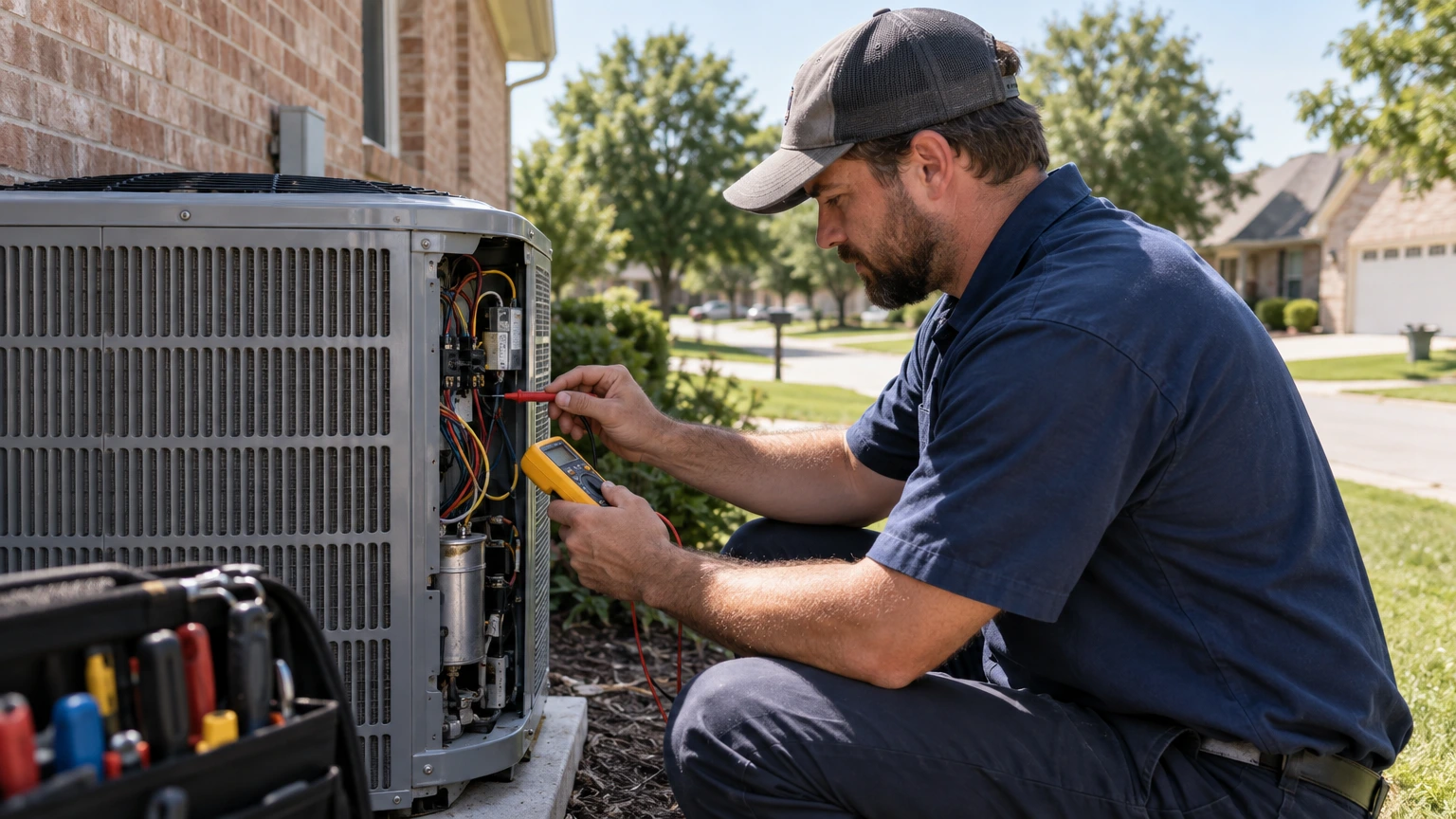
Your AC stopped cooling. A technician gives you a repair estimate, and now you're stuck with the question nobody wants to answer in July: do you fix it, or is it time to buy a new one?
I've sat at kitchen tables all over East Alton, Godfrey, and Edwardsville walking homeowners through this exact decision. Some units are worth fixing. Some are bleeding money every month you keep them running. Most fall somewhere in between, and the difference comes down to three numbers: how old the system is, what the repair costs, and what you've already spent keeping it alive.
Repair makes sense when the system still has good years left
If your AC is under 10 years old, well maintained, and the problem is isolated to a single component, repair usually makes sense. Common repairs like replacing capacitors, contactors, or thermostats cost a fraction of a new system, and if the rest of the unit is in good shape, that repair buys you several more summers.
Age matters here. A well-maintained air conditioner lasts 15 to 20 years, but heavy use in hot climates can reduce that lifespan to 10 or 12 years. East Alton summers put real strain on your system. If your unit is only six or seven years old and the blower motor fails, you fix it. You've still got half its life left.
The other thing I look for is repair history. One service call every few years is normal. If this is your first real issue in five years, repair it and move on. But if I've been to your house three times in two summers, you're looking at a pattern, not routine maintenance.
The 50% rule tells you when replacement wins
If a repair costs more than half the price of a new unit and your system is over 10 years old, replacement is the smarter financial move. This is the 50% rule, and it's the clearest line between fixing and replacing.
A new air conditioner system in East Alton typically starts around $4,500 to $6,000 depending on the size of your home and the efficiency rating you choose. Half of that is $2,250 to $3,000. So if your 12-year-old unit needs a $2,800 compressor replacement, you're better off putting that money toward new equipment with a 10-year parts warranty.
Compressor failure is often a sign to consider full system replacement instead of sinking money into a major repair on aging equipment. The compressor is the heart of the system. When it goes, other components aren't far behind.
There's a second formula worth knowing: the $5,000 rule. Multiply the age of your system by the estimated repair cost. If the total exceeds $5,000, replacement is frequently the better long-term investment. A $600 repair on a 10-year-old unit equals $6,000. That's over the threshold, which points toward replacement. The same repair on a 5-year-old unit equals $3,000. Well under. Fix it.
Rising energy bills mean your system is working too hard
Rising cooling bills without a rate increase or weather change indicate your air conditioning system is losing efficiency. When your usage habits stay the same but bills climb significantly, your air conditioner likely has efficiency problems that happen as equipment ages and components wear out.
Old systems burn money. Units with SEER ratings as low as 10 waste energy, while newer systems start at 14 SEER and can save homeowners 20 to 40% on cooling costs. That difference shows up every month from May through September in East Alton.
I've worked on air conditioners that are still cooling the house but costing $80 more per month to run than a new unit would. Over three summers, that's nearly $1,500 in wasted electricity. At that point, you're paying for a new system one utility bill at a time, but you never get the new system.
Frequent breakdowns cost more than the repair bills
One repair every few years is normal maintenance, but if you're calling for service multiple times per season, your system is telling you it's reached the end of its useful life. A single $900 repair on a 12-year-old furnace might be worth doing, but that same repair on a unit that already needed a $600 part last year and a $400 part the year before is not a repair, it's a subscription.
Add up what you've spent in the last 24 months. If you're approaching half the cost of a new system in repair bills alone, you've already paid for part of the replacement. The difference is you don't have the reliability, the warranty, or the efficiency that comes with new equipment.
I had a couple in Godfrey who spent $1,800 over 18 months on repairs to a 16-year-old air conditioner. Each repair seemed reasonable at the time. But when we looked at the pattern, they were spending hundreds annually to maintain equipment that was past its useful life. We replaced it, and they haven't called for a service issue since.
Refrigerant type can push you toward replacement
If your unit uses R-22 refrigerant, a simple leak repair costs a fortune because that gas is no longer made. R-22, also known as Freon, was phased out due to environmental concerns and is no longer produced in the U.S. Recharging systems with R-22 is extremely expensive and harder to find, and if your unit develops a refrigerant leak, repair becomes much more costly.
Most systems installed before 2010 use R-22. If yours does and it has a leak, you're looking at $90 to $150 per pound for the refrigerant, plus labor. A full recharge can cost more than $2,000. At that point, upgrading to a system that uses modern R-410A refrigerant makes financial sense and environmental sense.
When to call Steve for an honest assessment
Call me if your air conditioner is over 10 years old, if repair costs approach half the price of a new system, if your energy bills keep climbing, or if you've had multiple service calls in the last two years. I'll sit down with you, look at what's broken, and explain what makes sense for your home and your budget. No pressure, no upselling. A straight answer from someone who's been doing this for 21 years.
I know what it's like to face a big decision when the house is 85 degrees and you need cool air back fast. I'll give you the same advice I'd give my own family: fix it if it's worth fixing, replace it if it's not. Either way, you'll know the why behind the recommendation.
Ready to make the call?
If your AC is acting up and you're not sure whether to repair or replace, let's talk. I'll come out, diagnose the problem, and walk you through your options in plain English. You'll get a fair price, a clear explanation, and a system that keeps your home comfortable all summer. Schedule service.